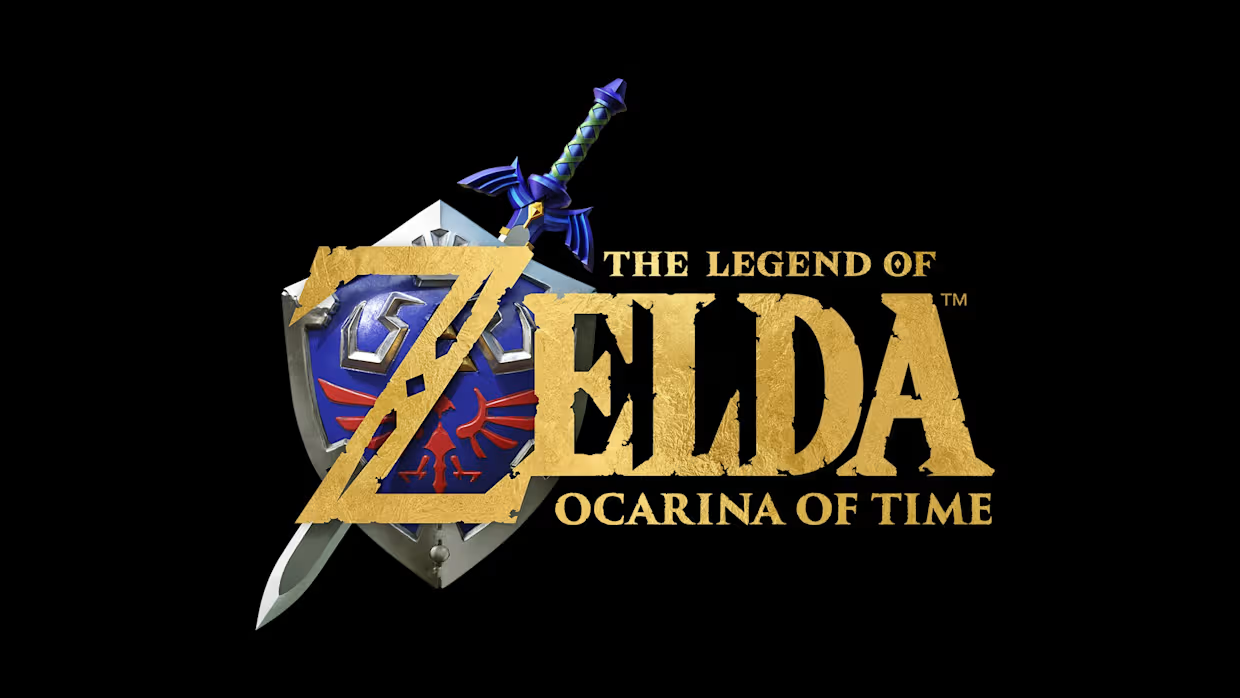
Official Announcement: The Legend of Zelda: Ocarina of Time
Some games are remembered because they were popular. Others are remembered because they changed the rules. The Legend of Zelda: Ocarina of Time belongs in that rare second group.
Originally released for the Nintendo 64, Ocarina of Time did more than bring Link into 3D. It created a blueprint for action-adventure games that developers are still learning from today. Lock-on targeting, cinematic boss fights, dungeon-based progression, horseback exploration, musical puzzles, time travel, emotional storytelling, and a world that felt alive — Ocarina of Time helped define all of it.
Now, with The Legend of Zelda: Ocarina of Time returning to the conversation through Nintendo Switch 2, a new generation of players is asking the same question longtime fans already know the answer to: why does this game still matter?
What Is The Legend of Zelda: Ocarina of Time?
The Legend of Zelda: Ocarina of Time is an action-adventure game starring Link, a young hero who leaves Kokiri Forest and journeys across Hyrule to stop Ganondorf, the Gerudo King of Thieves. The story grows from a classic childhood adventure into a darker tale about destiny, time, courage, and the cost of growing up.
At the center of the game is the Ocarina of Time, a magical instrument that allows Link to play songs with real power. Music is not just decoration here. It opens paths, solves puzzles, changes the world, and connects the player emotionally to Hyrule.
The game’s structure is simple to understand but powerful in execution: explore the world, enter dungeons, solve puzzles, gain new items, defeat bosses, and slowly uncover the larger battle for the Triforce.
Why Ocarina of Time Was Revolutionary
When Ocarina of Time launched, 3D gaming was still finding its language. Many developers were figuring out how players should move, fight, aim, explore, and interact in three-dimensional spaces. Nintendo answered those questions with confidence.
One of the biggest innovations was Z-targeting, a lock-on system that let Link focus on enemies during combat. This made sword fighting in 3D feel natural instead of chaotic. Many modern third-person action games still use ideas that can be traced back to this system.
The game also mastered world design. Hyrule Field acted as a central hub connecting forests, villages, mountains, lakes, castles, graveyards, deserts, and temples. By today’s standards, the map is not huge, but it feels meaningful because every location has purpose.
That is the secret of Ocarina of Time: it does not waste space. Every area teaches, rewards, or builds atmosphere.
A Story About Time, Growth, and Loss
Ocarina of Time starts with childlike wonder. Link wakes up in Kokiri Forest, meets Navi, receives a mission from the Great Deku Tree, and begins what feels like a heroic fairy tale.
Then the game changes.
When Link pulls the Master Sword, he awakens years later as an adult in a darker Hyrule ruled by Ganondorf. That shift is one of the most memorable moments in gaming history because it gives the player a sense of consequence. Time has moved forward. The world has suffered. Childhood is gone.
This is why the story still resonates. Ocarina of Time is not only about saving a kingdom. It is about growing up too quickly, carrying responsibility, and finding courage when the world feels broken.
Dungeon Design That Still Holds Up
Ocarina of Time’s dungeons remain some of the most iconic in the Zelda series. The Forest Temple feels mysterious and haunted. The Fire Temple brings danger and pressure. The Water Temple became famous for its complexity, frustration, and unforgettable design. The Shadow Temple leans into horror, while the Spirit Temple plays brilliantly with Link’s child and adult forms.
Each dungeon is built around a clear identity. They are not just levels. They are places with mood, logic, and mechanical themes.
Modern games often focus on massive scale, but Ocarina of Time reminds us that memorable design is about rhythm. Exploration, puzzle-solving, combat, item discovery, and boss encounters all build toward a satisfying payoff.
Music Is the Soul of the Adventure
Koji Kondo’s soundtrack is one of the reasons Ocarina of Time remains so beloved. Songs like Zelda’s Lullaby, Saria’s Song, Epona’s Song, Song of Storms, and Gerudo Valley are not just background tracks. They are part of the game’s language.
Players remember these melodies because they used them. You did not just hear the music — you performed it. That made the soundtrack interactive in a way few games had achieved at the time.
The result is a game where music, memory, and gameplay become inseparable.
Is Ocarina of Time Still Worth Playing Today?
Yes, but with the right expectations.
Players used to modern open-world games like Breath of the Wild, Tears of the Kingdom, Elden Ring, or Horizon may find Ocarina of Time smaller and more structured. But that is not a weakness. It is part of why the game works.
Ocarina of Time is worth playing today because it offers:
- Focused adventure design
- Strong dungeon progression
- Iconic music
- Memorable boss fights
- A legendary story
- Classic Zelda puzzle-solving
- One of gaming’s most influential worlds
Some parts feel dated, especially camera movement, user interface, and older control layouts. However, the core adventure remains strong because the game’s foundation is so well built.
Where Can You Play Ocarina of Time?
Players can experience Ocarina of Time through the Nintendo 64 version available in the Nintendo Switch Online + Expansion Pack library. Nintendo also released Ocarina of Time 3D for Nintendo 3DS, which updated the visuals, improved usability, and made the classic adventure more accessible on handheld hardware.
Nintendo has also brought Ocarina of Time back into the spotlight with a Nintendo Switch 2 version listed for 2026. That makes this the perfect time for both returning fans and new players to revisit why the original became such a landmark release.
Why the Nintendo Switch 2 Version Matters
A new version of Ocarina of Time matters because this is not just another retro game. This is one of Nintendo’s most important titles, and any modern return carries huge expectations.
Fans will want to see how Nintendo handles:
- Visual upgrades
- Controls and camera improvements
- Dungeon quality-of-life changes
- Music and sound design
- Story presentation
- The balance between nostalgia and modernization
The biggest challenge is respect. Ocarina of Time does not need to become a completely different game to feel modern. It needs careful updates that preserve the soul of the original while making the experience smoother for today’s players.
If Nintendo gets that balance right, Ocarina of Time could once again become a defining adventure for a new generation.
Ocarina of Time vs Modern Zelda Games
Compared to Breath of the Wild and Tears of the Kingdom, Ocarina of Time is more linear, dungeon-focused, and story-guided. Modern Zelda gives players freedom almost immediately. Ocarina of Time gives players a carefully paced heroic journey.
Both approaches are valuable.
Breath of the Wild changed Zelda by giving players open-ended freedom. Ocarina of Time changed Zelda by proving how powerful 3D adventure structure could be. Without Ocarina of Time, modern Zelda would look very different.
That is why it still belongs near the top of any “best Zelda games” conversation.
Pros and Cons
Pros
- One of the most influential adventure games ever made
- Excellent dungeon structure
- Iconic soundtrack
- Strong story about courage, time, and destiny
- Memorable bosses and characters
- Still rewarding for Zelda fans and retro gaming fans
- Important historical value for modern game design
Cons
- Original controls can feel dated
- Camera system may feel old to new players
- Some puzzles require patience
- Visuals from the Nintendo 64 era are naturally limited
- Water Temple may still test your patience
Expert Commentary: Why Ocarina of Time Became Legendary
Ocarina of Time became legendary because it solved problems that many 3D games were still struggling with. It made combat readable, exploration exciting, puzzles understandable, and cinematic storytelling feel natural in an interactive world.
But its real strength is emotional pacing. The game understands when to feel peaceful, when to feel dangerous, when to feel mysterious, and when to feel epic. Kokiri Forest, Hyrule Field, Kakariko Village, Gerudo Valley, the Temple of Time, and Ganon’s Castle all carry their own emotional weight.
That is why people still talk about it decades later. It is not just nostalgia. The design still teaches lessons.
| Timeline Section | Story Order | Zelda Game | Era / Placement | Copies Sold / Public Milestone | Why It Matters |
|---|---|---|---|---|---|
| Original Timeline | 1 | The Legend of Zelda: Skyward Sword | Earliest known era | Reported Original Wii: ~3.67M Skyward Sword HD: ~4.15M |
Explains the origin of the Master Sword, Hylia, and the long-running battle against evil. |
| Original Timeline | 2 | The Legend of Zelda: The Minish Cap | Early Hyrule history | Reported ~1.76M |
Introduces Vaati and explores an early version of Hyrule’s hero legends. |
| Original Timeline | 3 | The Legend of Zelda: Four Swords | Before Ocarina of Time | Not separated Bundled with A Link to the Past GBA in many sales references. |
Continues the Vaati storyline and introduces the Four Sword. |
| Timeline Split Point | 4 | The Legend of Zelda: Ocarina of Time | Hero of Time era | Public milestone N64: 7.6M 3DS remake: ~6.44M reported |
The key game that causes the Zelda timeline to split into three major branches. |
| Hero Is Defeated Timeline | 5A | A Link to the Past | Decline timeline | Reported ~4.61M |
Shows a Hyrule where the Hero of Time fails and Ganon’s power leads to a darker future. |
| Hero Is Defeated Timeline | 6A | Link’s Awakening | After A Link to the Past | Reported Original: ~3.83M Switch remake: ~6.46M |
A dreamlike adventure that follows Link outside Hyrule. |
| Hero Is Defeated Timeline | 7A | Oracle of Ages / Oracle of Seasons | Decline timeline | Reported ~3.99M combined |
Two connected adventures that expand Link’s journey beyond Hyrule. |
| Hero Is Defeated Timeline | 8A | A Link Between Worlds | Later decline timeline | Reported ~4.24M–4.26M |
Returns to the world structure of A Link to the Past while adding Lorule and wall-merging gameplay. |
| Hero Is Defeated Timeline | 9A | Tri Force Heroes | After A Link Between Worlds | Reported ~1.36M |
A lighter multiplayer-focused adventure connected to this branch. |
| Hero Is Defeated Timeline | 10A | The Legend of Zelda | Late decline era | Reported ~6.51M |
The original NES game, set in a weakened Hyrule threatened by Ganon. |
| Hero Is Defeated Timeline | 11A | Zelda II: The Adventure of Link | After the original Zelda | Reported ~4.38M |
Continues the NES-era story and remains one of the most unique games in the series. |
| Child Timeline | 5B | Majora’s Mask | After child Link returns | Reported N64: ~3.36M 3DS remake: ~3.46M |
Follows Link after Ocarina of Time in one of the darkest and most emotional Zelda stories. |
| Child Timeline | 6B | Twilight Princess | Later child timeline | Reported ~8.93M combined HD remaster: ~1.16M |
Shows the consequences of Ganondorf’s fate after the child ending of Ocarina of Time. |
| Child Timeline | 7B | Four Swords Adventures | Child timeline | Limited data Widely treated as one of the lower-selling mainline entries. |
Brings back the Four Sword and features another major conflict involving Ganon. |
| Adult Timeline | 5C | The Wind Waker | After adult Link disappears | Reported / Official HD GameCube: ~4.43M reported Wind Waker HD: 2.37M official |
Shows a flooded Hyrule where a new Link rises after the Hero of Time becomes legend. |
| Adult Timeline | 6C | Phantom Hourglass | After The Wind Waker | Reported ~4.76M |
Continues the seafaring story of Link and Tetra. |
| Adult Timeline | 7C | Spirit Tracks | Later adult timeline | Reported ~2.96M |
Moves the story into a new Hyrule built around trains, spirits, and a different Zelda partnership. |
| Wild Era / Separate Placement | Final Era | Breath of the Wild | Far future / separate from classic split | Official Nintendo Switch: 33.84M All versions combined: ~35M+ reported |
Reimagines Hyrule as a massive open-air world set long after many ancient legends. |
| Wild Era / Separate Placement | After Breath of the Wild | Tears of the Kingdom | Direct sequel to Breath of the Wild | Official Nintendo 22.56M |
Expands the Wild era with sky islands, the Depths, Zonai history, and a new Ganondorf conflict. |
COMFYPLAYER Note: The classic Zelda timeline splits after Ocarina of Time into the Hero Is Defeated, Child, and Adult timelines. Breath of the Wild and Tears of the Kingdom are usually treated as part of a far-future Wild era, with Nintendo not placing them neatly into one classic branch.
Sales Note: “Official Nintendo” means Nintendo has published the figure in its investor sales data. “Reported” means the number comes from widely cited public sales databases or historical reporting and should be treated as an estimate, especially for older releases and remakes. Sales can vary depending on whether original versions, remasters, ports, or combined editions are counted.
Final Thoughts
The Legend of Zelda: Ocarina of Time is more than a classic Nintendo game. It is one of the foundations of modern action-adventure design. Its world, music, dungeons, targeting system, time-travel story, and emotional sense of growth helped shape what players expect from epic 3D adventures.
Yes, parts of it feel old today. But great design does not disappear with age. Ocarina of Time remains worth playing because it understands adventure at its purest level: leave home, face fear, grow stronger, save the world, and discover what courage really means.
For longtime fans, it is a return to one of gaming’s most important journeys. For new players, it is a chance to understand why so many people still call it one of the greatest games ever made.
At COMFYPLAYER, we will keep following every update on Zelda, Nintendo Switch 2, remakes, classics, and modern adventure games. Plug it in, change the world.
FAQ
What is The Legend of Zelda: Ocarina of Time about?
The Legend of Zelda: Ocarina of Time follows Link as he travels across Hyrule and through time to stop Ganondorf from taking control of the Triforce and ruling the kingdom.
When did Ocarina of Time originally release?
The original Ocarina of Time released for the Nintendo 64 in 1998.
Is Ocarina of Time still worth playing in 2026?
Yes. Ocarina of Time is still worth playing because of its dungeon design, music, story, world structure, and influence on modern 3D adventure games.
Is Ocarina of Time on Nintendo Switch?
Yes. The Nintendo 64 version is available through Nintendo Switch Online + Expansion Pack.
Is Ocarina of Time coming to Nintendo Switch 2?
Nintendo has listed The Legend of Zelda: Ocarina of Time for Nintendo Switch 2 with a 2026 release window.
What makes Ocarina of Time so important?
Ocarina of Time helped define 3D action-adventure gameplay with lock-on targeting, cinematic dungeon design, item-based progression, and a world built around exploration and discovery.
Is Ocarina of Time better than Breath of the Wild?
They are different types of Zelda games. Ocarina of Time is more structured and dungeon-focused, while Breath of the Wild is more open-ended and exploration-driven. Both are essential Zelda experiences.
What is the best version of Ocarina of Time?
Many players prefer Ocarina of Time 3D because it improves visuals, menus, and usability. However, the Nintendo 64 version remains the original historic experience.
Is Ocarina of Time good for new Zelda players?
Yes, especially for players who want to understand the roots of modern Zelda. New players should expect older controls and visuals, but the adventure itself remains powerful.